
Sustainability leaders know that carbon, water, and health are interconnected, but addressing these priorities in a single strategy has been challenging to operationalize. To help solve this, our updated Coolfood technical note delivers a scalable, science-based framework establishing 2035 climate and health targets for food service providers. This updated methodology expands beyond greenhouse gas emissions to integrate water footprint and health metrics. Read on to see how these new targets work in practice and how to leverage this data to balance climate goals with other sustainability goals.
Expanding our climate targets to 2035
When Coolfood was launched in 2019, it was the first initiative to set a target for food-related GHG emissions, setting a 2030 target against a 2015 baseline. With 2030 less than five years away, we updated our Coolfood targets to align with the latest research on emissions reduction pathways and target setting guidelines. Our updated 2035 targets were set based on review of the IPCC’s AR6 emissions reduction pathways and SBTi’s Forest Land and Agriculture (SBTi FLAG) guidance. Both the SBTi FLAG guidance and the AR6 pathways incorporate more recent food and agriculture sector emissions, compared to the original Coolfood target which was set based on 2010 data. The addition of the 2035 target also enables prospective members to join with a more realistic emissions reduction timeline.
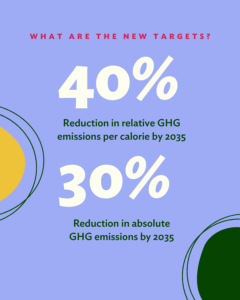
The new targets call for a 30% reduction in absolute GHG emissions and a 40% reduction in relative emissions per calorie by 2035, relative to a 2025 baseline. The 2035 targets call for steeper reductions because the food and agriculture sector has not yet achieved the necessary emissions reductions, so accelerated collective progress is needed to meet global climate targets.
Integrating targets to advance healthier diets
Shifting our diets to include more plant proteins is important for reasons beyond climate, as plant-rich diets are a cornerstone of people’s health globally. Diets that are higher in vegetables, fruits, pulses, nuts, seeds, and whole grains—and lower in red and processed meats—are associated with a lower risk of chronic diseases. Food and health are inextricably linked, and with these updates, the Calculator now supports members in tracking and evaluating their progress toward health priorities alongside environmental impacts. For many members such as hospitals and schools, serving healthy meals aligns with their broader mission; these changes allow them to better see trends and make decisions to advance these goals.
The targets prioritize the two food groups that need to be increased the most based on member food purchases compared to the EAT-Lancet 2.0 Planetary Health Diet: 1) legumes, nuts, and seeds and 2) vegetables. The targets are set for the share of food purchased by weight to reach 6% for legumes, nuts, and seeds, and 15% for vegetables by 2035.
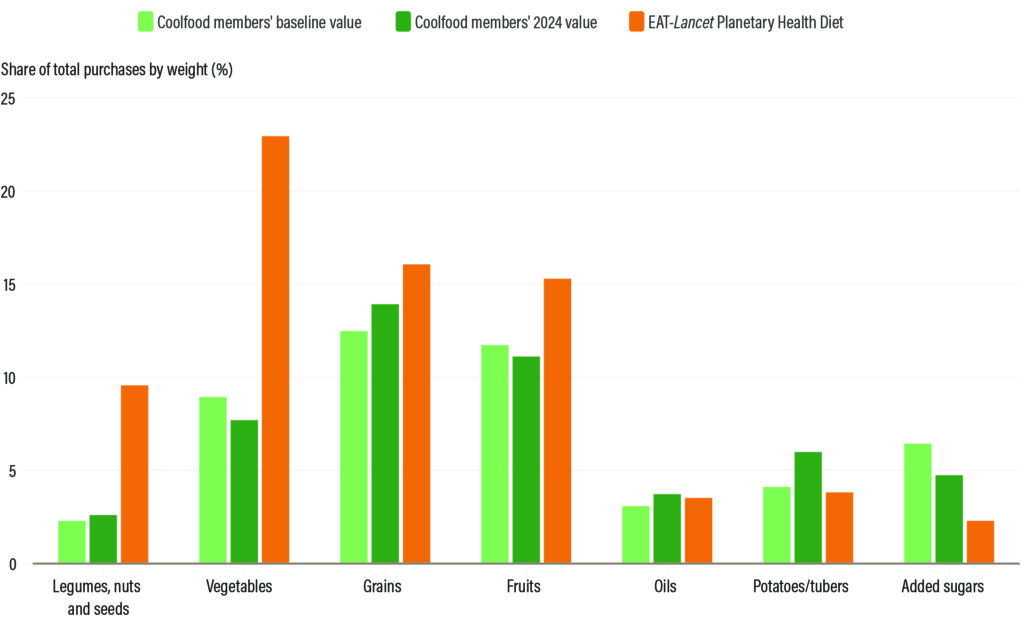
These targets are based on the share of food purchased by weight because of their simplicity and effectiveness. This information is already available from member data, so it does not create a new reporting burden on members. The intent of these targets is to ensure that efforts to reduce food-related GHG emissions and other environmental impacts not only maintain but also improve the nutritional quality of members’ food offerings by shifting toward an increased amount of legumes, nuts, and seeds as well as vegetables offered.
Comparing different water footprints of food
While our official targets remain focused on climate and health, shifting from animal-based to plant-based foods generally reduces the water footprint associated with producing the foods that organizations purchase as well. To help track this co-benefit, we have added water footprint data directly into the Coolfood Calculator. This update provides another lens for procurement, allowing members to compare specific foods—such as evaluating the water footprints of different animal products or of plant-based milk alternatives—and track these shifting impacts over time alongside greenhouse gas emissions and land use.
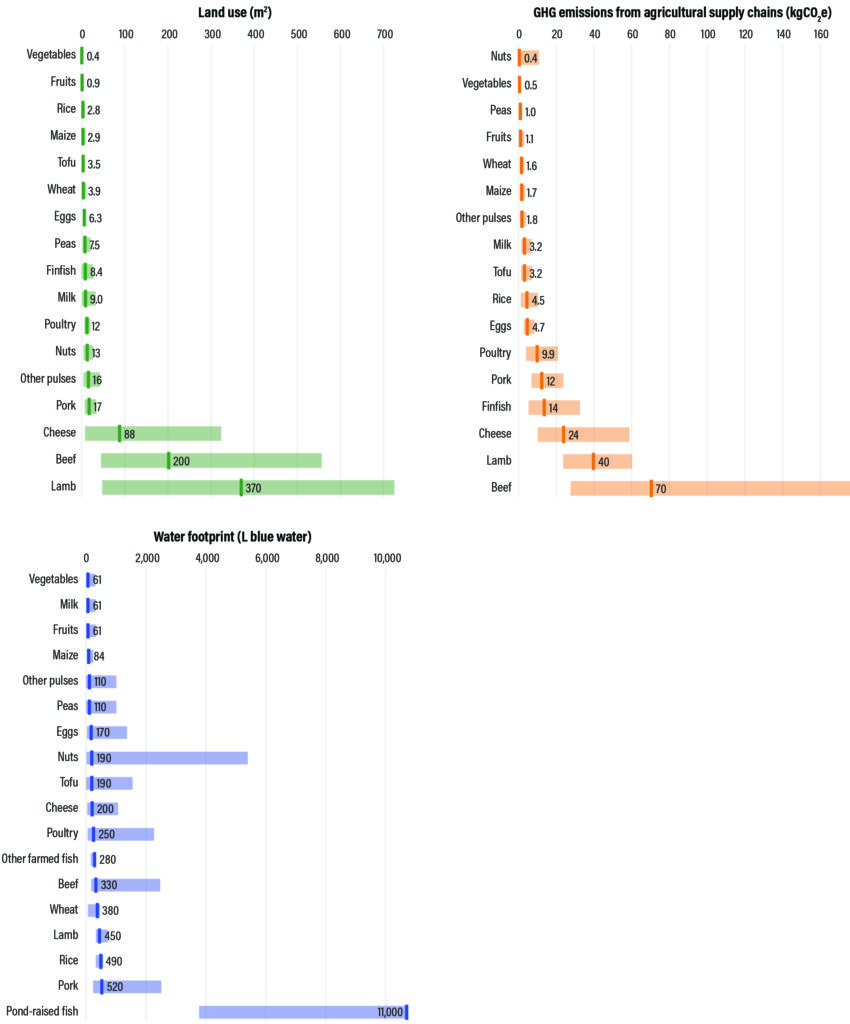
Sustainable water use is essential for continued agricultural production and for mitigating water scarcity as the demand for water to irrigate crops is projected to rise by 16 percent by 2050, and agriculture is already responsible for 70 percent of global water withdrawals. The blue water footprint accounts for surface and groundwater while the green water footprint accounts for soil moisture from precipitation. Together, the blue and green water footprints are known as the consumptive water footprint, accounting for most of the water used in agriculture and livestock production. More detail is provided in the technical note on the sources and methodology for calculating the new water footprint metric.
Driving impact for people and planet
Working toward a sustainable food system is a balancing act, but better data simplifies the equation. By integrating climate targets with expanded metrics on nutrition, land use and water footprints, food service providers have the tools to navigate co-benefits and tradeoffs with multiple sustainability goals.
With these updates, the Coolfood Calculator tracks a broader suite of metrics across your procurement strategy:
- Greenhouse gas emissions: Measuring and mitigating carbon footprints.
- Land occupation: Tracking agricultural land use changes.
- Water footprint: Comparing the water use of different foods to manage scarce resources.
- Health: Measuring the volume of plant-rich proteins and vegetables served.
Ultimately, this updated framework operationalizes these connections to advance procurement that supports a higher quality of life for people and a sustainable future for the planet.